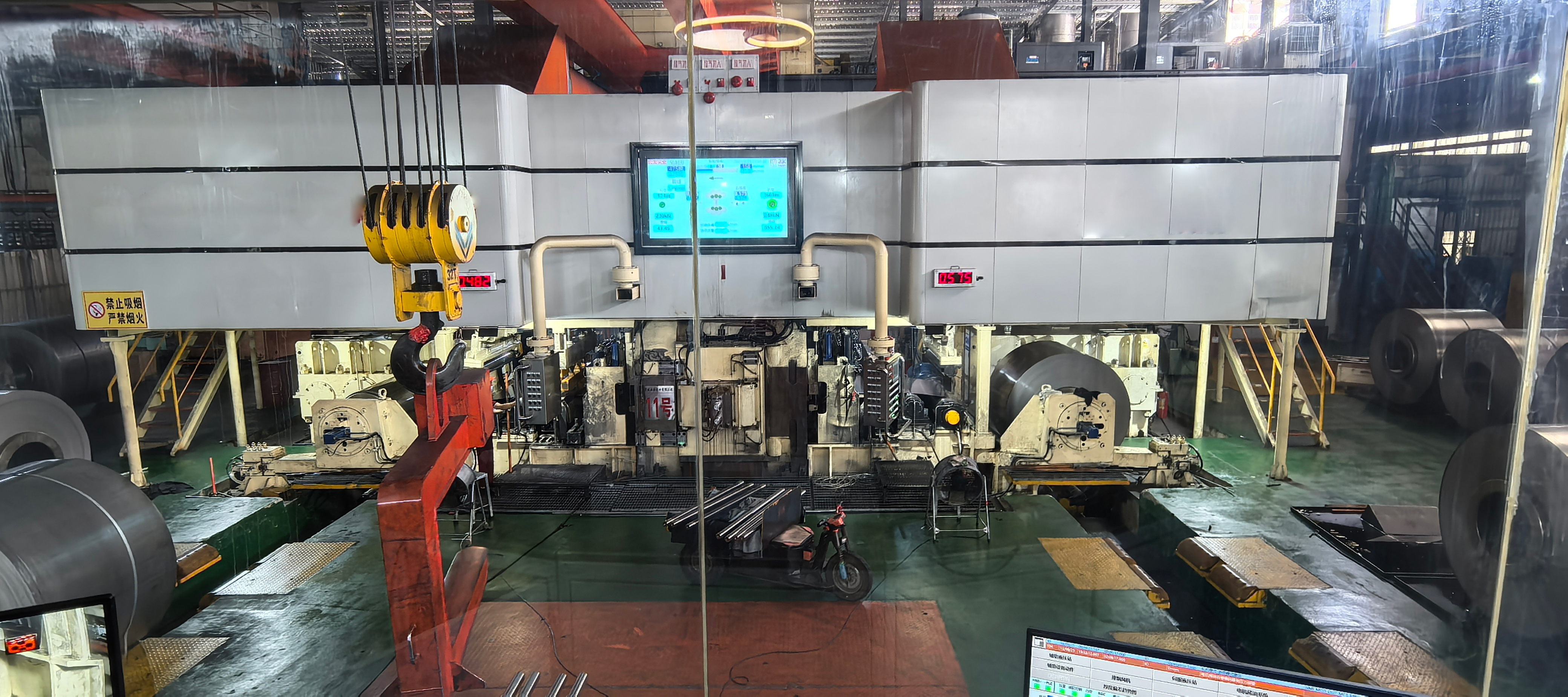
Tension leveler and stretch-bend leveling
Intelligent flatness control for continuous strip finishing
JINYE tension levelers improve strip shape before cleaning, annealing, coating, slitting or final inspection, with coordinated tension control and automation-ready operation.
Application
Shape correction without losing line stability
A tension leveler must be selected according to yield strength, strip thickness, tension window, target elongation, incoming shape, automation level and production speed. JINYE reviews those variables together with the surrounding intelligent coil processing sections.
- Reference models include double-bend single-leveling, double-bend double-leveling and 23-roll leveling configurations.
- Speed synchronization and tension control reduce the risk of creating new flatness defects.
- Can be integrated with cleaning, annealing, coating, inspection or energy saving slitting processes.
Reference specifications
Tension leveler model ranges
Data is based on the supplied parameter table. Final selection depends on material strength, strip thickness, tension, elongation and line speed.
| Model | Width range (mm) | Speed range (m/min) | Application direction |
|---|---|---|---|
| Double-bend single-leveling | 350 / 450 / 550 / 650 / 750 / 850 / 950 / 1050 / 1150 / 1450 / 1780 | 500-800 | General strip flatness improvement in continuous lines. |
| Double-bend double-leveling | 350-1780 | 500-800 | For stricter flatness targets or more complex incoming strip shape. |
| 23-roll tension leveler | 350-1780 | 500-800 | Finishing-section flatness control with coordinated tension and speed. |
Control focus
Leveling system priorities
Tension stability
Entry and exit tension control must be stable enough to keep the strip flat without process shocks.
Elongation control
Target elongation is set according to material strength and flatness requirement.
Line data matching
The leveler must match cleaning, annealing or slitting sections to protect full line capacity and reduce manual correction work.